
A new HMO is refused if 10% of homes within 50m are already HMOs. Mid-terraces are out, and two and three-bed homes near a school are protected.
Dartford Borough Council has adopted a set of planning rules for houses in multiple occupation that puts hard numbers on decisions which used to be arguments. They have been in force since 25 June, they apply to every HMO application in the borough, and the council’s Development Control Board is being formally trained on them this Wednesday.
The rules sit in the Guidance for Planning Applications for Houses in Multiple Occupation, a supplementary planning document adopted on 25 June 2026 alongside two others, on settlements and on the Darent riverside. A report going to the board on 17 September confirms all three took effect immediately and says the new policies “can be a weighty factor when considering a planning application” (Development Control Board, 17 September 2026).
The numbers that now decide it
The document runs to 27 pages and six policies, H1 to H6. These are the parts that will settle most applications:
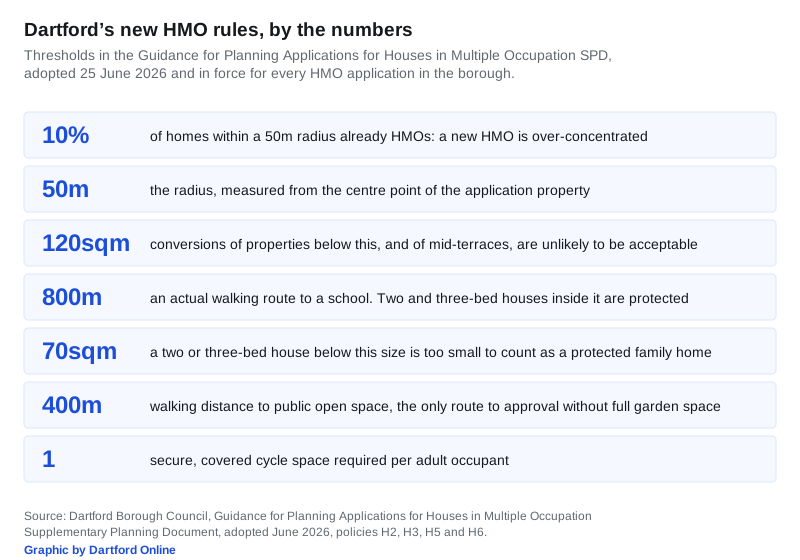
- Over-concentration (H3). A new HMO should be refused where 10% or more of the residential dwellings within a 50m radius of the site already are, or would become, HMOs. The radius is measured from the mapped centre point of the application property, and every flat in a block counts as one dwelling
- Sandwiching (H3). A proposal should be refused if it leaves a single family house sandwiched between two or more HMOs on the same street, or if it extends an HMO already in a run of three or more
- Unsuitable houses (H2). Converting a mid-terrace, or any property under 120sqm, is “unlikely to be acceptable”
- Protected family homes (H2). Converting a two or three-bedroom house within an 800m walking route of a school is “a substantial dis-benefit” and likely to be resisted. The 800m must be an actual, confirmed walking route, not measured as the crow flies, and it covers all mainstream primary and secondary schools. Houses under 70sqm are excluded, on the basis that they are too small to count as family homes in the first place
- Garden space (H5). An HMO is expected to keep at least as much private amenity space as the family house it replaces. Where there is not enough, permission is unlikely unless the property is in the urban area and within 400m walking distance of a public open space
- Noise (H4). Where a communal room or a stairwell would share a party wall with a neighbour’s first-floor bedroom, the proposal “will be resisted unless adequate noise mitigation is evidenced”. Any floor area with a ceiling under 1.5m does not count as usable space
- Cycle parking (H6). One secure, covered cycle space per adult occupant, with a level route to the highway
One limit on the concentration rule is worth knowing if you are objecting to something. The council will count only HMOs it knows to be lawful: licensed where a licence is required, or with planning permission, or confirmed lawful by the council. In the document’s own words, “alleged, unlicensed or unverified HMOs cannot be counted”.
The first test is on Wednesday, and it is already a near miss
The rule met a real application almost immediately. The board decides on 17 September whether to allow an HMO at the Woodman public house, 106 East Hill, and the officer’s report works straight through the new policies.
On the concentration test, the report finds there are three other HMOs in the vicinity, none immediately adjacent, and that the proposal “results in 10.8% of properties within a 50m radius being HMOs”. The officer’s words: that is “fractionally over the suggested threshold in the SPD of 10%”.
The recommendation is still to grant, for a temporary period. The officer gives two reasons for accepting what the report calls “the small breach in the percentage threshold”: the mixed use of the existing site, and the temporary nature of the proposal. The report also records that the Woodman clears the other bar, because it is not a mid-terrace, not a three-bedroom house and larger than 120sqm.
So the first thing the 10% rule does in practice is get set aside, on reasons the officer has set out in writing. The board can take a different view on Wednesday. Our earlier report on the application is here.
Why the council says it needed this
The document is unusually direct about the evidence behind it. Dartford is the most densely populated borough in Kent, and the council says the recent acceleration in HMOs “has been most pronounced in areas with high population densities, for example in the largely residential areas and older houses surrounding Dartford town centre”. It links those neighbourhoods to “some of the worse incidences of noise complaints, parking stress and crime reports”.
Two census figures do the heavy lifting on the terraced-housing rule. Newtown’s housing stock was 56.5% terraced at the last census, and Swanscombe’s 49.4%. The council’s argument is that HMO pressure concentrates on exactly that stock.
A third figure explains the school rule. Dartford was the only authority in the region whose average age fell at the last census, to 37.4 years against 41.6 for Kent as a whole, and the borough has been one of the fastest growing nationally for its child population. The council’s case is that two and three-bedroom houses near schools are the stock it can least afford to lose. It also notes plainly that HMOs “do not provide affordable housing that meets the definition of affordable housing”.
Every HMO now needs planning permission here
The reason any of this bites is a separate decision the council took earlier. Two Article 4 directions have removed the national permitted development right that let a house or flat become a small HMO of up to six people without applying for anything.
- before: conversions to HMOs of more than six occupants needed permission; small ones did not
- now: “every proposal for a new HMO within the borough will require planning permission”, large or small
That is why the council expected application numbers to rise, and why it wrote the guidance.
One thing to watch
The council’s own supplementary planning documents page links the formal adoption statement for each of the three SPDs, but its opening line still reads “Dartford is consulting on new SPDs, proposed to be introduced in June 2026”. The adopted document itself is clear that it was adopted on 25 June, and the committee report says the same. If you are relying on the council’s web page to work out whether these rules are live, they are.
What it means for you
If an HMO application has gone in near you. Two numbers are worth checking before you comment: whether 10% or more of the dwellings within 50m are already lawful HMOs, and whether the property is a mid-terrace or under 120sqm. Both are now written policy rather than a matter of opinion. Comments go through the planning register.
If you live next door to a proposed HMO. Policy H4 is the one that helps you. If a communal room or the stairwell would back onto your first-floor bedroom, the council says the application should be resisted unless the applicant evidences noise mitigation, and it can impose sound insulation beyond building regulations as a condition.
If you own a two or three-bedroom house near a school. The council has placed a policy presumption against it becoming an HMO, provided it is over 70sqm and there is a genuine walking route of 800m or less to a mainstream school.
If you are converting a property. The floor area test is measured as originally built, the cycle storage requirement is one space per adult, and a garden cannot simply be built over. The full document sets out what a planning statement needs to address.
If you want to speak at Wednesday’s meeting. Only people who have already commented on an application, plus the applicant and their agent, may speak, one for and one against, for three minutes each. Registration is on 01322 343987.
Sources
- Dartford Borough Council: Guidance for Planning Applications for Houses in Multiple Occupation, Supplementary Planning Document, adopted June 2026 (adoption date 25 June 2026 at paragraph 1.2; policies H1 to H6 including the 10% within 50m concentration test, the sandwiching and run-of-three tests, the 120sqm and mid-terrace test, the 800m school walking route and 70sqm floor area, the 400m open space distance, the 1.5m ceiling height rule and one cycle space per adult occupant; the lawful-HMO counting rule at paragraph 4.29; the Article 4 directions at paragraphs 1.8 and 1.9; the census and density evidence at paragraphs 2.7 and 4.15, and the average age figures at 4.25)
- Dartford Borough Council, Development Control Board, 17 September 2026 (the member training report “Supplementary Planning Policies”, confirming the three SPDs were adopted on 25 June 2026 with immediate effect and can be “a weighty factor”; and the officer’s report on 26/00288/FUL, the Woodman public house, which records 10.8% of properties within a 50m radius as HMOs, calls it “fractionally over the suggested threshold in the SPD of 10%”, and recommends granting temporary permission)
- Dartford Borough Council: supplementary planning documents (the page carrying each SPD and its adoption statement)
The Development Control Board had not met when this was published. We will report what it decides.
Have your say