
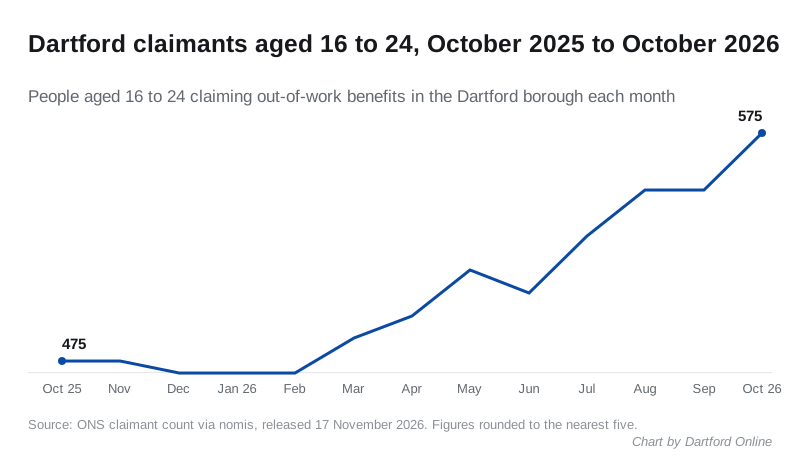
2,625 people in the Dartford borough claimed out-of-work benefits in October, up 190 in a year. Claimants aged 16 to 24 reached 575, the most since July 2021.
Overview
2,625 people in the Dartford borough were claiming out-of-work benefits in October 2026. That is 55 more than in September and 190 more than a year earlier. Claimants aged 16 to 24 rose to 575, the highest number since July 2021.
The figures come from the ONS claimant count, published on 17 November.
The October figures
October’s total is 7.8 per cent higher than October 2025, when 2,435 people were claiming. It is the borough’s second highest count since 2021, five below the 2,630 recorded in June this year.
As a share of residents aged 16 to 64, the rate is 3.3 per cent. That compares with:
- 3.4 per cent across Kent County Council’s area
- 3.2 per cent across the South East
- 4.1 per cent across England
All figures are from nomis. They are rounded to the nearest five, so the age bands below do not add up exactly to the total.
Young people are driving the rise
The number of claimants aged 16 to 24 has risen in most months this year. It went from 475 in October 2025 to 575 in October 2026, an increase of 21 per cent. The last time it was higher was July 2021, at 585.
Comparing October 2026 with October 2025, by age:
| Age | October 2025 | October 2026 | Change |
|---|---|---|---|
| 16 to 24 | 475 | 575 | +100 |
| 25 to 49 | 1,475 | 1,510 | +35 |
| 50 and over | 485 | 540 | +55 |
Under-25s make up about a fifth of the borough’s claimants but account for more than half of the rise over the year. The over-50s count of 540 is the highest for that group since November 2021, according to nomis.
Where in the borough
The ONS publishes the count for each of Dartford’s 20 wards. The highest rates in October, as a share of residents aged 16 to 64, were:
- Temple Hill: 315 claimants, 4.9 per cent
- Swanscombe: 225 claimants, 4.8 per cent
- Princes: 175 claimants, 4.5 per cent
- Newtown and Town: 4.1 per cent each
The lowest was Heath, at 1.8 per cent. Ebbsfleet saw the largest monthly rise, from 160 claimants in September to 180 in October. Ward figures are small and rounded, so a change of five or ten in one month can be noise.
Dartford against the rest of Kent
| Area | Claimant rate, October 2026 |
|---|---|
| Thanet | 5.4% |
| Gravesham | 4.3% |
| Medway | 4.2% |
| Folkestone and Hythe | 3.9% |
| Swale | 3.6% |
| Dover | 3.5% |
| Maidstone | 3.5% |
| Dartford | 3.3% |
| Canterbury | 3.3% |
| Ashford | 3.0% |
| Tonbridge and Malling | 2.5% |
| Tunbridge Wells | 2.5% |
| Sevenoaks | 2.4% |
Dartford sits mid-table among Kent’s 13 districts and unitary areas. Neighbouring Gravesham’s rate is a point higher, at 4.3 per cent.
What this figure is, and what it is not
The claimant count is not the unemployment rate:
- it counts people claiming Jobseeker’s Allowance, plus Universal Credit claimants who are required to look for work
- someone in a low-paid or part-time job can be included if their earnings are low enough
- someone out of work who does not claim is not counted at all
- the ONS classifies these local figures as official statistics in development
The latest month is often revised. July’s count was first published as 2,645 and now stands at 2,605.
What it means for you
- If you have lost work, Universal Credit is claimed online, and the claim date sets when payment starts, so there is no advantage in waiting. (Universal Credit, GOV.UK)
- If your income has dropped, Dartford Borough Council’s Council Tax Reduction scheme is not automatic and has to be applied for.
- If you are aged 16 to 24, the DWP’s jobcentre finder lists your nearest office by postcode.
The ONS publishes the November figures next month.
Sources
- Nomis claimant count dataset (NM_162_1), used for the borough series, the age bands, the wards and the Kent comparison, released 17 November 2026
- ONS claimant count by unitary and local authority
Have your say