
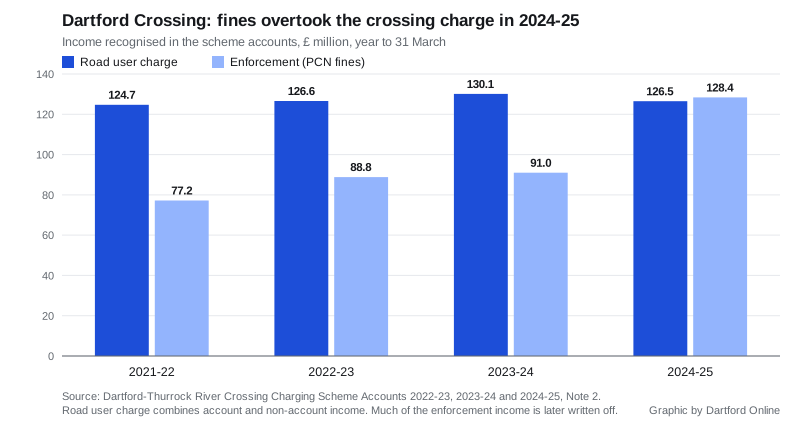
Audited accounts show Dart Charge fines raised £128.4m in 2024-25, more than the £126.5m in crossing charges. Dartford residents can cap their bill at £25.
Fines took more money off drivers at the Dartford Crossing last year than the crossing charge itself. Penalty income reached £128.4m in the year to 31 March 2025, against £126.5m from the road user charge. It is the first year, in the four covered by the last three sets of published accounts, in which the penalties out-earned the toll they exist to enforce. (Dartford-Thurrock River Crossing Charging Scheme Accounts 2024-25, Note 2)
The accounts are audited by the Comptroller and Auditor General and laid before Parliament. They were signed on 26 January 2026 by National Highways’ accounting officer Nick Harris and chief financial officer Scott Dale, and published on GOV.UK on 29 January.
Where the £255.3m came from
Total income for the year was £255.3m, up £33.7m, or 15.2 per cent, on the £221.6m of the year before. It breaks down as:
- £78.9m road user charge from drivers with a Dart Charge account
- £47.6m road user charge from drivers without one
- £128.4m enforcement income, meaning Penalty Charge Notices
- £289,000 abnormal load charges
- £117,000 rental income
Enforcement income rose 41.1 per cent in a single year, from £91.0m. The road user charge went the other way, down from £130.1m, because fewer people crossed. Total chargeable crossings fell from 50.2 million to 49.4 million, and overall traffic was down 1.7 per cent.
The rise is a backlog, not a crackdown
The accounts are explicit about the cause, and it is worth knowing before reading the figure as a Dartford motorist being squeezed harder.
Dart Charge moved to a new operating model in July 2023. PCNs stopped going out. A large backlog of unpaid crossings built up, none of which had reached the point where a penalty could be issued. Those notices were then issued during 2024-25, at over half a million a month against a normal average, and the income was booked in that year.
The backlog was formally cleared by May 2024. National Highways says in the accounts that enforcement income is “expected to return to more typical levels in 2025-26”.
Compliance actually improved over the year, from 93.2 per cent to 94.5 per cent. Compliance here means paying by midnight on the day after crossing, as the rules require.
Most of the fine money is never collected
The headline penalty figure is what the accounts recognise as income, not what lands in the bank. In the same year:
- £103.4m of enforcement receivables were written off as unlikely to be recovered
- £8.0m of unpaid road user charges were written off
- £43.2m of PCNs already issued were cancelled, either because a first-time user paid the crossing charge within the 14-day warning period or because a challenge or appeal succeeded
- £20.6m of recorded crossings never became a PCN at all, because the keeper could not be traced, the number plate could not be read, the vehicle was cloned, or a system or supplier error intervened
After £177.2m of expenditure, the net proceeds handed to the Department for Transport were £78.0m, up from £72.3m. That money is not ring-fenced for the crossing or for Dartford. The accounts state it is set against the department’s general transport spending and “not hypothecated to specific programmes or projects”.
3,387 drivers were overcharged, and a refund scheme is running
The accounts disclose a separate problem. In April 2025, National Highways found that one of its contracted enforcement agent suppliers had been adding extra enforcement visit fees to customer cases that should not have been charged.
Its initial investigation identified 3,387 affected customers and a total overcharge of £1.1m. A refund scheme was launched by the supplier on 7 July 2025. National Highways suspended sending the supplier new work, and only allowed it to resume in January 2026. The Enforcement Conduct Board has taken over a wider investigation, because the problem was not limited to Dart Charge cases.
What it means for you
If you live in the Dartford borough, you do not have to pay the standard rate. The local resident discount caps a year of crossings at:
- £25 a year for unlimited crossings
- £12.50 a year for 50 crossings, topped up at £6.25 for another 25, or £12.50 to move to the unlimited plan
You will never pay more than £25 in a year on either plan. You need a Dart Charge account, a copy of your V5C log book and any two documents proving you live inside the Dartford or Thurrock council boundary. If you stop paying the annual fee the discount is removed and you have to apply again.
Without the discount, the charge between 6am and 10pm, every day of the year including bank holidays, is:
| Vehicle | One-off or pay as you go | Pre-pay |
|---|---|---|
| Motorcycles, mopeds, quad bikes | Free | Free |
| Cars, motorhomes, minibuses up to 9 seats | £3.50 | £2.80 |
| Two-axle vans, buses, goods vehicles | £4.20 | £3.60 |
| Vehicles with more than two axles | £8.40 | £7.20 |
Drivers who get free UK vehicle tax because of a disability do not pay, and the vehicle is checked automatically.
Miss the midnight deadline and the fine is £70, halved to £35 if you pay within 14 days and raised to £105 if you do not pay within 28 days, on top of the crossing charge you owed. You can pay or challenge a PCN online, by post to Dart Charge Enforcement, PO Box 842, Leeds LS1 9QF, or pay by phone on 0300 1313 120. You cannot challenge one by phone.
What happens next
The Autumn Budget 2025 named a Regulated Asset Base model as the government’s preferred way to finance the Lower Thames Crossing. Under it, the accounts say, ownership and operation of the Dartford Crossing itself would move to “a new regulated private sector entity”, overseen by a regulator, running both crossings. That needs new primary legislation, which the government says it intends to bring forward “when parliamentary time allows”.
The Lower Thames Crossing was granted development consent in March 2025.
For live closures and diversions on the crossing and the roads around it, see our Dartford roadworks and travel page. For rail alternatives into London, see Dartford train times, and for town-centre charges, parking in Dartford.
Figures are from the Dartford-Thurrock River Crossing Charging Scheme Accounts for 2024-25, 2023-24 and 2022-23, all laid before Parliament. Charges and penalty amounts are from GOV.UK.
Have your say