
Dartford landlords face fines from £3,000 to £40,000 under a new council policy going to Cabinet on 29 October. Illegal eviction starts at £35,000.
Private landlords in Dartford who break housing law could be fined between £3,000 and £40,000 without going to court, under a new council policy.
Dartford Borough Council’s Cabinet is asked to approve it on Thursday 29 October. The policy sets a starting fine for each offence, then adjusts it for the size of the landlord’s business and how bad the breach was. It is in the Cabinet papers.
A civil penalty is a fine the council can impose instead of prosecuting. The council says it wants those who fail tenants to be “duly punished”, and for the fines to deter others. Any money collected must be spent on more private rented enforcement work.
Why it is changing
The Renters’ Rights Act 2025 gave councils new fines and raised old ones. The council’s draft policy says:
- the top fine for breaching a banning order, or for electrical safety failures, has gone up from £30,000 to £40,000
- councils can now fine for unlawful eviction and harassment, up to £40,000, instead of only prosecuting
- there are new fines of up to £7,000 for tenancy breaches linked to the end of section 21 “no-fault” evictions
- there are new fines of up to £7,000 for rental bidding, for leaving the rent out of an advert, and for turning away families with children or people on benefits
What each breach would cost
These are the starting points in the draft policy, before any adjustment:
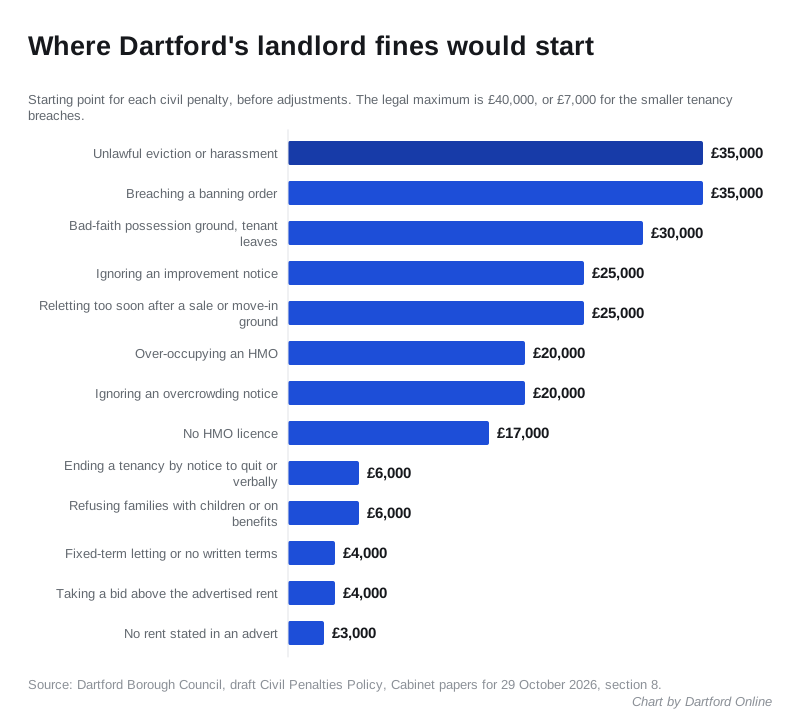
Some of these need explaining:
- Bad-faith possession ground, £30,000. This is where a landlord uses a ground for possession knowing, or not caring, that it would fail in court, and the tenant moves out within four months.
- Reletting too soon, £25,000. Landlords who end a tenancy to sell or move in may not relet or remarket the home during a restricted period afterwards.
- Ending a tenancy by notice to quit or verbally, £6,000. The starting point is £3,000 if the landlord simply fails to warn the tenant in advance that a possession ground may be used.
- Electrical safety fines start at £5,000, £12,500 or £20,000, depending on which duty was broken.
Where an HMO breaks several management rules, the council will issue a separate fine for each one. Failing to take safety measures in an HMO starts at £20,000.
How a fine goes up or down
The starting point then moves:
- up by 20% for larger or more experienced landlords: anyone who has ever had six or more properties or three or more HMOs, a corporate landlord, or a director of one
- down by 20% only for a landlord with no more than two properties, no more than one HMO, and very limited experience
- down by up to 20% for mitigation, such as fixing the problem quickly or accepting liability
- down by 15% if the final fine is paid in full within 28 days
The policy gives a worked example. A landlord with two HMOs fails to licence one: the fine starts at £17,000. After the landlord’s representations, the council sets it at £16,000. Paid within 28 days, it falls to £13,600.
A landlord can appeal to the First-tier Tribunal (Property Chamber) within 28 days of the final notice.
Coming in June 2027
From 15 June 2027, landlords will have to be on a new private rented sector database. The policy says landlords will then face:
- up to £7,000 for marketing or letting a home without a proper database entry
- up to £40,000 for giving the database false or misleading information
Two people responded
The council consulted on the policies from 24 August to 18 September. It received two responses. The changes it made after them add detail on how the council works with Kent Fire and Rescue Service on fire hazards in HMOs and blocks of flats, according to the consultation log.
What it means for you
- If you rent privately and your landlord tries to evict you without following the law, or leaves serious hazards unrepaired, you can report it to the council’s private sector housing team.
- If you are a landlord, the fines in the draft policy set out what the council will charge for each breach. Larger and corporate landlords start 20% higher.
- Looking at an HMO? Our story on the Priory Road and Whitby Close HMO decisions explains how the council treats new HMOs in planning.
We will report Cabinet’s decision on Thursday.
Have your say