
2,645 people in the Dartford borough were claiming out-of-work benefits in July, the most since October 2021. Under-25s are up 20 per cent in a year.
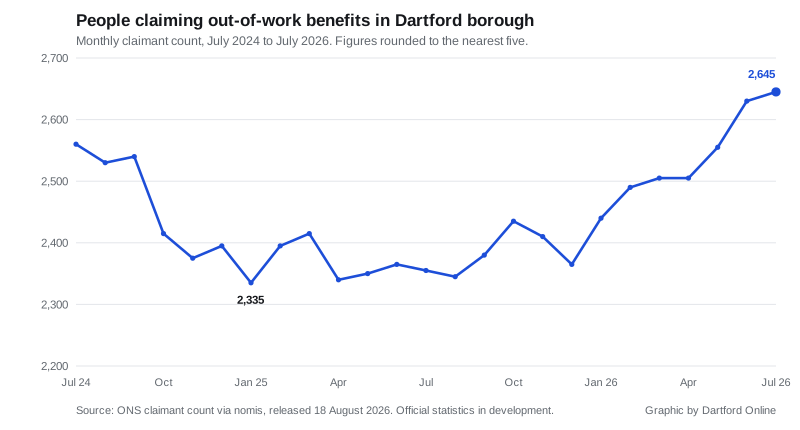
2,645 people in the Dartford borough were claiming out-of-work benefits in July, according to figures published by the Office for National Statistics on 18 August. That is 290 more than in July last year, and the highest monthly total the borough has recorded since October 2021. (ONS claimant count via nomis)
The count has now risen in six of the last seven months. Its lowest point in the last two years was 2,335 in January 2025, and it has climbed by 310 since then.
Under-25s are rising fastest
The ONS also splits the count by age. Comparing July 2026 with July 2025:
- Aged 16 to 24: 535, up from 445, a rise of 20 per cent
- Aged 25 to 49: 1,575, up from 1,445, a rise of 9 per cent
- Aged 50 and over: 540, up from 465, a rise of 16 per cent
Young people make up about a fifth of the borough’s claimants but account for nearly a third of the increase over the year. Figures are rounded to the nearest five, so the age bands do not sum exactly to the headline total.
Dartford against the rest of Kent
As a share of residents aged 16 to 64, Dartford’s rate is 3.3 per cent. That is below the Kent average of 3.4 per cent and well below England’s 4.0 per cent, though above the South East figure of 3.1 per cent.
| Area | Claimant rate, July 2026 |
|---|---|
| Thanet | 5.4% |
| Gravesham | 4.2% |
| Medway | 4.2% |
| Folkestone and Hythe | 3.8% |
| Maidstone | 3.5% |
| Swale | 3.5% |
| Canterbury | 3.3% |
| Dartford | 3.3% |
| Dover | 3.3% |
| Ashford | 3.0% |
| Tonbridge and Malling | 2.5% |
| Tunbridge Wells | 2.5% |
| Sevenoaks | 2.3% |
Dartford sits in the middle of the county, joint seventh of the thirteen districts and unitary areas alongside Canterbury and Dover. A year ago its rate was 3.0 per cent.
What this figure is, and what it is not
The claimant count is not the unemployment rate, and treating it as one overstates the picture:
- it counts people claiming Jobseeker’s Allowance, plus Universal Credit claimants who are required to look for work
- someone in a low-paid or part-time job can be included if their earnings are low enough to keep them in that group
- someone out of work who does not claim, or whose partner earns too much for them to qualify, is not counted at all
- the ONS classifies these local figures as official statistics in development, its label for a series still being refined
The comparison with 2021 also needs care. The pandemic pushed the borough’s count to 4,170 in May 2020, so today’s 2,645 is far below that peak. It is, though, the highest reading in nearly five years.
What it means for you
- If you have lost work, Universal Credit is claimed online and the claim date sets when payment starts, so there is no advantage in waiting. (Universal Credit, GOV.UK)
- If your income has dropped, Dartford Borough Council runs a separate Council Tax Reduction scheme, which is not automatic and has to be applied for. (Council Tax Reduction, Dartford Borough Council)
- If you are behind on rent, the council also has discretionary housing payments for people already receiving housing support. (Discretionary payments)
- For face-to-face help, the DWP publishes a jobcentre finder by postcode. (Find your nearest jobcentre)
Council Tax Reduction is worked out against your band, so it is worth checking which band your home is in before you apply.
The August figures are due on 15 September.
Sources
- ONS claimant count by unitary and local authority, released 18 August 2026
- Nomis claimant count dataset, used for the borough series, the age breakdown and the Kent comparison
- Universal Credit and Dartford Borough Council benefits
Have your say