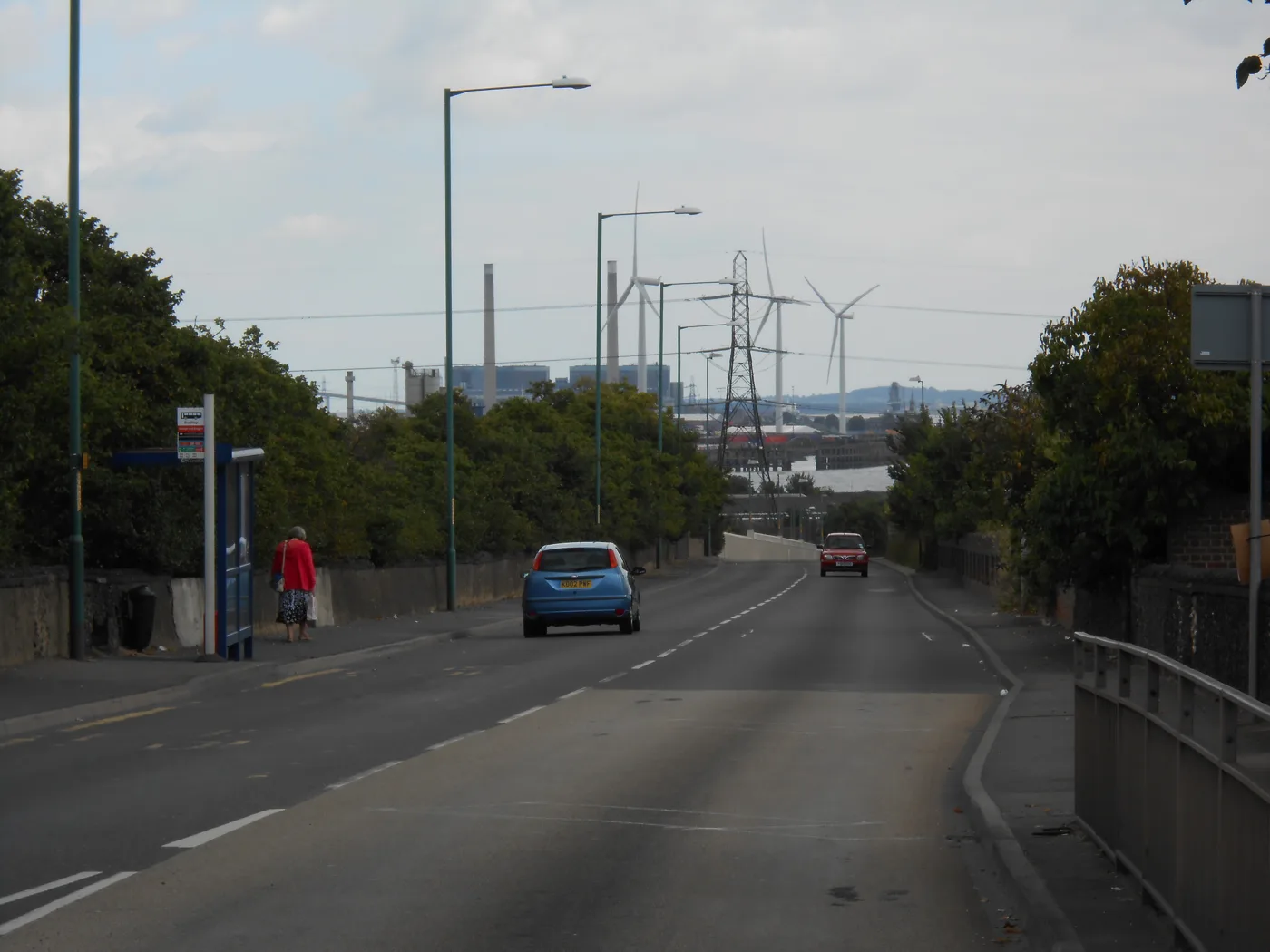

Kent has spent £1.186m keeping the collapsed A226 safe and puts the rebuild at about £50m. Bids closed on 3 August and a government decision is due this autumn.
Kent County Council’s bid to rebuild the collapsed A226 Galley Hill Road is now sitting with the Department for Transport, and the answer is due in the autumn. The deadline for submissions to the government’s Structures Fund was 23:59 on 3 August 2026, and KCC’s own committee record confirms that Galley Hill is the county’s primary bid, with the A299 put in as a secondary one. (Applying for grant funding from the Structures Fund, Department for Transport; draft minutes, Growth, Environment and Transport Cabinet Committee, 5 May 2026)
For Swanscombe and Greenhithe that is the closest thing to a decision point since a section of the chalk spine between Swanscombe High Street and Snowden Hill, Northfleet gave way on 10 April 2023, taking part of the carriageway and footway with it and damaging buried utilities. The road has been shut ever since.
What the council’s own file says the money is
The figures below are not estimates from outside. They come from the report Simon Jones, KCC’s Corporate Director of Growth, Environment and Transport, put to the Cabinet Member for Highways and Transport, Peter Osborne, under decision 26/00019. (26-00019 A226 Galley Hill Road report, Kent County Council)
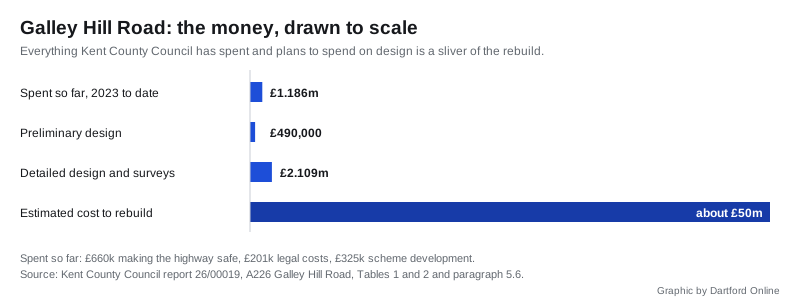
KCC has already spent £1.186m on a road nobody can drive down: £660,000 on operational work to make the highway safe, £201,000 on legal costs and £325,000 on developing a scheme. That money came from existing revenue budgets and from the council’s reserves.
The rebuild itself is put “in the region of £50 million”. Getting to the point where anyone could start building costs a further £2.599m: £490,000 for preliminary design, which covers structural and geotechnical work (£214,000), ecology surveys (£135,000), initial planning (£11,500) and the business case (£190,500), then £2,109,000 for detailed design and the survey work that goes with it. The council’s plan is to have that design finished by autumn 2026.
Two lines in that report explain why the bid matters so much. Highway authorities do not insure against the failure of highway structures, and the scale of this collapse means the cost “cannot be met from existing asset management or highways maintenance budgets”. There is no budget line for Galley Hill at all; it appears in KCC’s budget book as a risk.
There is also a complication of ownership. KCC is the highway authority and carries the duty under section 41 of the Highways Act 1980 to maintain the road, but it does not own the chalk cliff holding the road up. Its responsibility, the report says, “is limited to the carriageway construction”.
The odds, honestly
The Structures Fund opened on 15 April 2026 and is worth £1 billion across England. It is explicitly available for “local highway repairs that are needed due to landslips and collapses of geological structures”, which is why Galley Hill qualifies at all.
It is also tight. Each local highway authority may normally submit one scheme, and a second only in exceptional circumstances it has to justify. The department states in its own guidance that “it is expected that the fund will be over-subscribed” and that some authorities “may not secure funding”. Any scheme that does win money has to have the work finished by 31 March 2030.
Kent’s officers told the May committee the process in stages: a draft submission to the government’s Technical Advisory Body by 19 June, the full and final proposal by 3 August, then assessment by that body and the DfT, with funding decisions expected in the autumn.
What happens if the answer is no
The committee asked. The minutes record that in the event of an unsuccessful bid, KCC would pursue “further action to recover the affected land” and would include “efforts to restore the road, subject to the outcome of ongoing investigations into liability for the defect”. In other words, the fallback is legal, not financial, and it depends on establishing who is to blame.
There was one wobble on the money in May. The £490,000 for preliminary design was to come from an internal feasibility reserve, and that reserve turned out not to be available. Officers told members an alternative had since been found and that there was “no current risk to progressing the scheme”. If the Structures Fund bid succeeds, the report notes, that spending would be capitalised and absorbed by the grant.
Members from all parties backed the scheme, put on record their thanks for the bid and for the £1m-plus spent so far, and asked for a standing update at future meetings so the bid and the project can be tracked. The May decision itself, published on 22 May and effective from 2 June, approved taking the design through to detailed design stage, carrying out public engagement, and preparing and submitting the funding bids. It pointedly did not approve construction: that needs a separate decision later. (Decision 26/00019, Kent County Council)
What it means for you
If you live in Swanscombe, Greenhithe or Ebbsfleet, the practical position has not changed this week and will not change before the autumn. The road stays shut. The closure was made under section 14(1)(b) of the Road Traffic Regulation Act 1984 and covers the stretch from the B259 High Street to the Snowden Hill junction, with the town council’s published record of the order giving an estimated duration of 36 months. (Galley Hill Road collapse updates, Swanscombe and Greenhithe Town Council)
What has changed is that there is now a date to hold people to. If nothing is announced by the end of the autumn, that is a question worth putting to your county councillor. The affected division is Swanscombe and Greenhithe, and the KCC report names its member as Cllr Thomas Mallon, alongside the two members for Northfleet and Gravesend West on the far side of the collapse.
The buses matter as much as the cars. KCC’s own case for the scheme rests partly on restoring the Fastrack network along the corridor, and its equality assessment, last updated in March 2026, found that people in the age, disability, pregnancy and maternity, and carer responsibility groups have been hit hardest by the closure. Those are the residents for whom a reopened road is not a convenience.
One promise in the May decision is worth holding on to whatever the DfT says: KCC gave approval “to carry out public engagement on the proposed scheme”. That engagement has not happened yet. When it does, it is the point at which residents get a say in what the rebuilt road looks like, and it is worth turning up to.
For the wider picture on how the borough’s roads and building work are changing, see our Dartford roadworks and travel updates and Dartford planning applications pages, or the rest of our Dartford news.
Have your say